Friday, 20 September 2013

Lecture 3

Architecture with Iklas (Sincerity)

Ikhlas (sincerity) in our actions and statements is of utmost importance for the acceptance of our deeds. Al-Bukhari and Muslim narrated that ‘Umar said, "I heard the Messenger of Allah say:
"Verily, the reward of deeds depends upon the Niyyah (intentions) and every person will get the reward according to what he has intended."

Therefore, every action that was not performed solely for Allah’s Sake, is annulled and fruitless in this life and the Hereafter.There are 2 ways to express one's submission to God:
-outward physical action
-inward action of the heart

Both expressions can be express by removing doubts from the heart, aqidah/belief is achieve. Sincerity of the heart involves practicing deep contemplative as well as constant thoughtful and spiritual feelings of nature and of man. These actions can be done in the form of prayer, meditation and by ones social behaviour.
The best way to architecturally translate the union of sincerity and purity through design motivation is to build within conformity to God's will. Not ignoring the fact that this is achieved by having the absence of human idols or that of the artwork in Islamic architecture consists of the elements of nature. By having gardens through which running waters flow gives the sense of delight. Reflection, refraction and transformation of light rays produced from the water makes the buildings more rich in terms of beauty, grace, and elegance.

Alhambra Palace, Granada
-Courtyard consist of water feature which gives the sense of sincerity and delight.


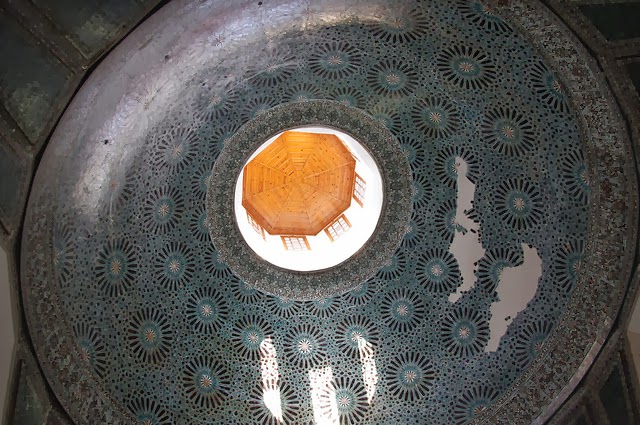
Example Of Architecture of sincerity: Integration of Mathematics where the architecture embodies the geometric proportion, harmony and balance. For example, the Karatay Madrassa (School of Sacred Science). The school acts as to response to the people's needs. It has central dome which is open to the sky. This evoke the feeling of celestial non-materiality as well as intellectual beauty.

Karatay Madrassa


Central dome of Karatay Madrassa

Architecture as Pursuit of ‘Ilm (Knowledge)

Architecture of Knowledge is one of the most prominent forms or identification of a Islamic building other than the architectural elements. These element mainly comes from the presence of Islamic writings and verses from the Quaran in the form of Islamic calligraphy.

In Islamic religion, knowledge is very important to be spread and this is applied in architecture through the inscriptions that are on the walls of the sacred buildings. These inscriptions come from the Quran and it is displayed on the walls instead of displaying any form of idols.

In Islam, calligraphy is the highest art form because it represents the writing of the divine script. The Islamic calligrapher is the most revered of artists because thier work is seen as the purest form of religious expression. The Islamic calligraphy is an empowering and sacred form of visual expression portraying the message of the Qur’an, which was revealed in the Arabic language. Architecture expressed in the form of light is visible where illuminating effects of the suns rays and moonlight reveal the inscriptions and it is a moving source of nature therefore gives one a more spiritual experience of that space.

Inscription from La Puerta del Perdon, Sevilla Cathedral, 12th century

Friday, 13 September 2013

Lecture 2

Architecture of Tawhid (devotion & faith): [Unity & Uniquity (Oneness) of Allah]

The term tawhid, is an important cornerstone in the conceptual framework for Islamic architecture. It means asserting the unity or oneness of Allah. Tawhid is the Islamic concept of monotheism. The word tawhid is derived from the words wahid and ahad which mean “one”, “unique” and “peerless”. Based on the concept of tawhid, Muslims believe that God cannot be held equal in any way or degree to any other being or concept. Maintaining that there is no God except Allah and that there is nothing comparable to Him constitutes the essence of tawhid and the essence of Islam. Thus, declaring God’s oneness, tawhid, together with Prophet Muhammad’s prophethood (shahadah), is the first requirement for one who wishes to embrace the Islamic religion. Shirk, or associating anybody or anything with God making it comparable to Him, is the opposite of tawhid. It is the gravest sin which God vowed never to forgive.

Notion of Tawhid: al Quran - haqiqa (formless essence) revelation/enlightenment - nature of
                           space, forms, order, orients – place man the presence of Divine Unity.
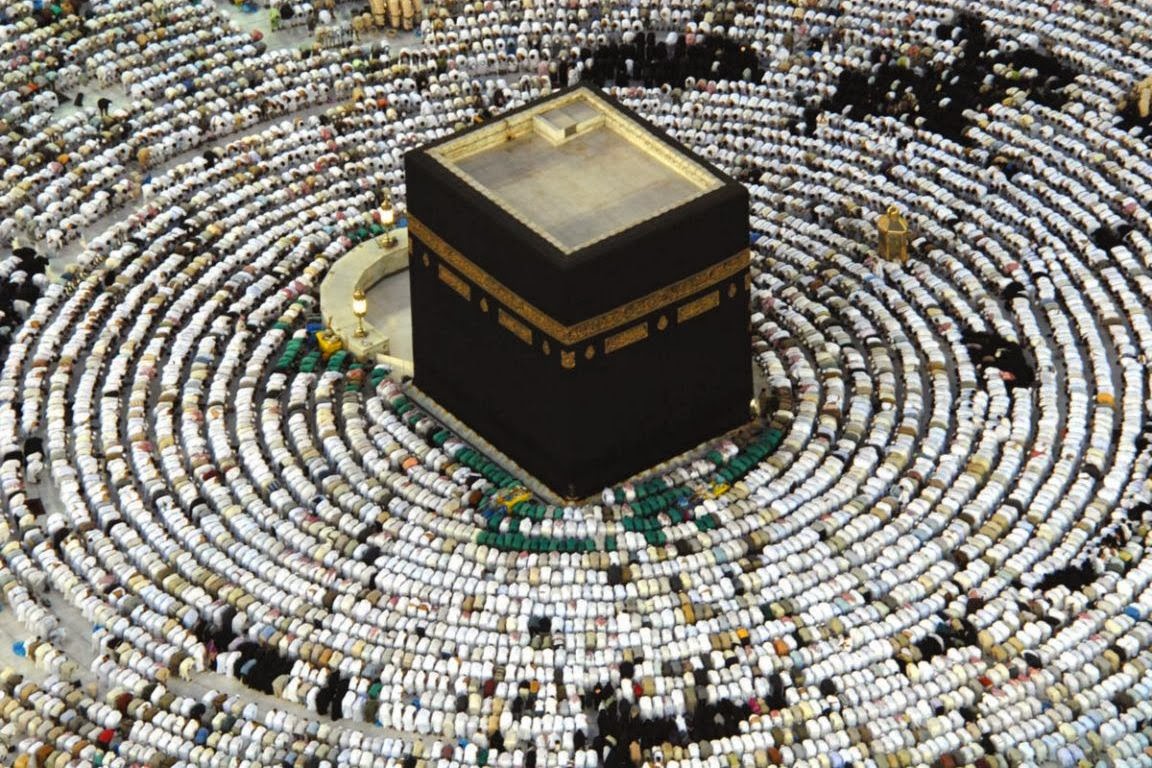
Main architecture of Allah Unity & Uniquity is: Ka’bah : towards which Muslims face their five daily
                                                                                prayers


The Kaaba

Called: Holy Ka'bah - cube shape, Ancient House, Al-Bait Al-Haram, Abraham's Building & 
Qibla- prayer faces it, Continuously-Visited House.
Al-Masjid al-Haram, the most sacredmosque in Islam, is built around the Kaaba. Muslims are expected to face the Kaaba during prayers, no matter where they are. From any given point in the world, the direction facing the Kaaba is called the Qibla.

Construction & Reconstruction of Ka'bah:


Scholars and historians say that the Kaba has been reconstructed between five to 12 times.
The very first construction of the Kaba was done by Prophet Adam (peace be upon him). Allah says in the Quran that this was the first house that was built for humanity to worship Allah. After this, Prophet Ibrahim and Ismail (peace be upon them) rebuilt the Kaba. The measurements of the Kaba's Ibrahimic foundation are as follows:
-the eastern wall was 48 feet and 6 inches
-the Hateem side wall was 33 feet
-the side between the black stone and the Yemeni corner was 30 feet
-the Western side was 46.5 feet

Following this, there were several constructions before the Prophet Muhammad (peace and blessings be upon him) time.


Virtue of Ka'bah


Architecture of Ihtiram (Respect, propriety or adab): [good manners to God, fellow man and oneself]

Architecture of Ithiram is the presence of showing respect, propriety and good manners to Allah, to fellow mankind and to oneself. The Muslims follow the 5 pillars which are shahada, salat, zakat,fasting and haji which encourages and shows respect to the faith and God. By following these actions, it helps to purify oneself and also builds up inner and outer spiritual fulfilment which finally submit ones own will to Allah. Prophet Muhammad Allah S.A.W is the perfect example of propriety and praiseworthy characteristics. The Al Quran is a guide to practice respect as a virtue for the sake of Allah.

Architecture of Ihtiram are greatly shown through symbolism. The harmony and the purity of geometric shapes of the Ka'Bah can be found in all sacred Islamic architecture throughout the Islamic world. God made the Ka’bah (the cube), the Sacred House, a symbol for mankind. The Cube Geometry linked the idea of ‘centre'. The idea thus is the fundamental of the traditional architecture.
Ka'bah:
i: each face of the cube corresponding to the primary directions -zenith and nadir
ii: whilst the four corners point towards the cardinal points of the universe.
iii: Ka`bah - the underlying point of convergence between essential cosmic principles and mosque  
    architecture in the world.


Pure/Divine Cube Geometry


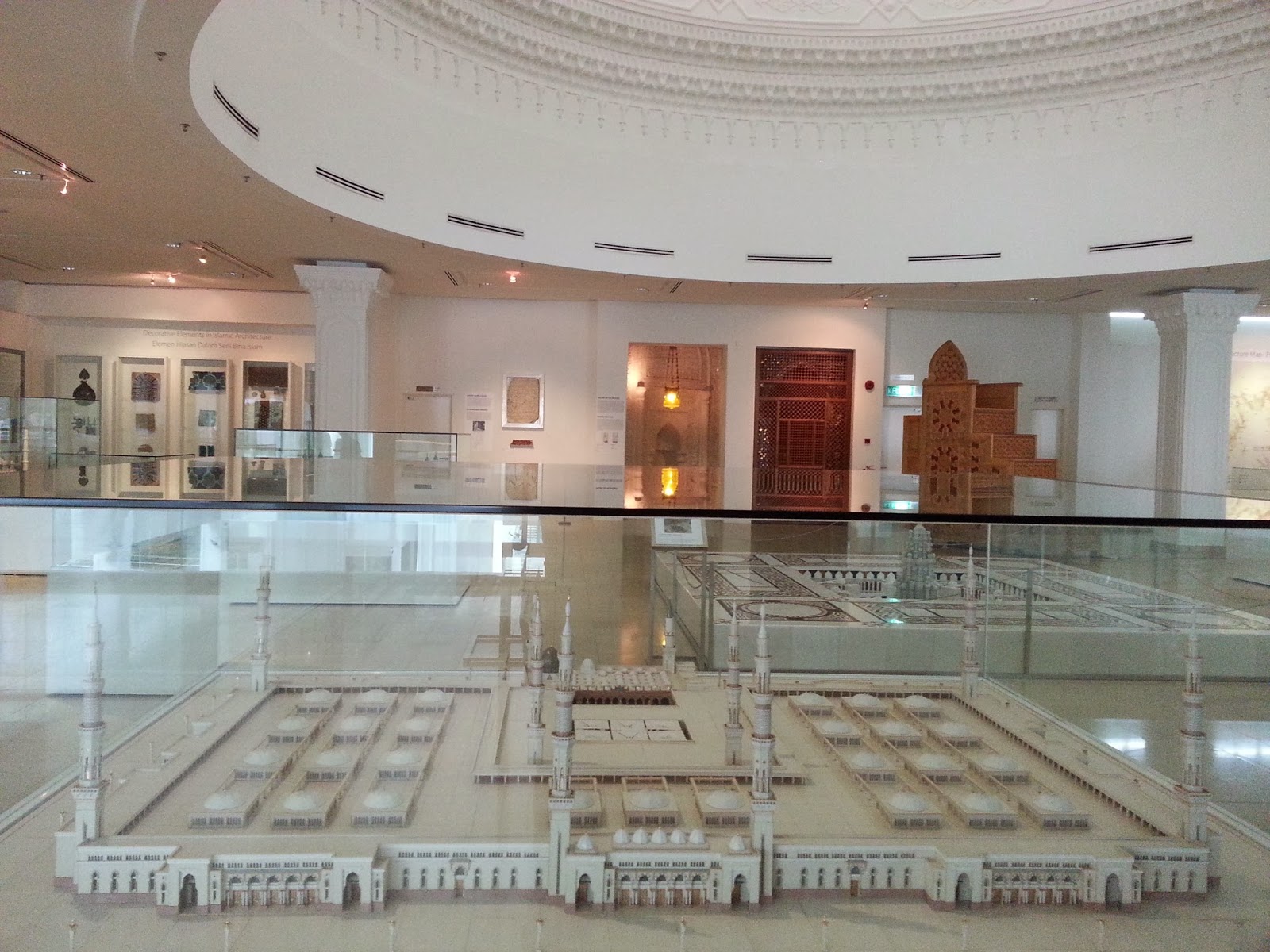
Architecture of Ihtiram is also shown through respecting the essence of Islam & humanity: example of building as sanctuary- Masjidil Haram & Masjidil An Nabawi: 
i: Conservation of Par excellence
ii: Waqf – stop, contain and preserve - religious endowment -a voluntary & irrevocable dedication of  
               one's wealth or a portion of it -cash or kind - benefits - community in general- permanent 
               donation. Once - created, it can never be donated as a gift, inherited
iii: Sanctuary – Sheltered Court Yard- Suffah, gallery, porticos surround courtyard. Housing for the 
    Sufis, homeless

Friday, 6 September 2013

Lecture 1

Islamic Architecture
Islamic architecture encompasses a wide range of both secular and religious styles from the foundation of Islam to the present day. The most important building in the Islamic world is the mosque, followed by the royal palace. Mosques, as the centre of worship, were among the first buildings erected in the Islamic world. Invading armies did not require elaborate buildings in which to pray; as long as they knew the direction of Mecca in order to face it when praying, Muslims were then - and are still today - able to perform their prayer duties. The first mosques Muslims constructed, therefore, were simple squares. As the Islamic empire grew in size and power, mosques became larger and more elaborate. In the areas around the Mediterranean Sea, most mosques followed a so-called "open plan," with a courtyard in the centre, roofed arcades, and the first minarets - towers that extend vertically from the mosque.

Islamic architecture is 

-Expression of faith

-Looking heavenwards
-Divine present/acknowledge of The Almighty Allah
-Conceive with Devotion
-Religious Conviction
-Place a premium on Reasons – the Feelings of God Magnificence does not Defy Rational  
 Explanation

Definition of Islamic Architecture:

Architecture inspired by The Glorious Allah

Architecture to realize the Pillars of Islam
Architecture as Pursuit of Knowledge
Architecture as Pursuit of Beauty
Architecture guided by Al Mighty Allah
Architecture according to Sharia’: Al-Quran, Al- Hadith & Ijtihad Ulama’

Prophet Muhammad S.A.W
Prophet Muhammad was born in Mecca around 570 AD comes from the tribe of Qureish which was from the 40 clans lived in Mecca with varying status and wealth. Prophet Muhammad is known as Al Amin and was respected for his skill in trade and married a wealthy widow name Khadijah binti Khuwaylid. During the solitary vigils that he first heard God’s message, he Meditated in the hillside outside the city. The Qur'anic revelation begins in the Cave of Hira on the Jabaal an Nur the " Mountain of Light" near Mecca where Prophet  Muhammad S.A.W is commissioned as the Messenger of ALLAH.


The Quran
Qu'ran is the very word of God Almighty: a complete record of the exact words revealed God. It is the principle source of every Muslim's faith and practice. It deals with all subjects that concernus as human beings,including wisdom, doctrine, worship and law. The Qu'ran is a guidance book, a criterion to distinguish right from wrong, lawful from unlawful and ritually pure from ritually impure.


Pillars of Islam
1. Shahadah
"There is none worthy of worship except God and Muhammad is the messenger of God." This declaration of faith is called the Shahadah, a simple formula that all the faithful pronounce. The significance of this declaration is the belief that the only purpose of life is to serve and obey God, and this is achieved through the teachings and practices of the Last Prophet, Muhammad.

2.Salah
Salah is the name for the obligatory prayers that are performed five times a day, and are a direct link between the worshipper and God. There is no hierarchical authority in Islam and there are no priests. Prayers are led by a learned person who knows the Qur'an and is generally chosen by the congregation.

3. Zakah
An important principle of Islam is that everything belongs to God, and that wealth is therefore held by human beings in trust. The word zakah means both "purification" and "growth." Our possessions are purified by setting aside a proportion for those in need and for the society in general. Like the pruning of plants, this cutting back balances and encourages new growth.

4. Hajj
The pilgrimage to Makkah (the hajj) is an obligation only for those who are physically and financially able to do so. Nevertheless, over two million people go to Makkah each year from every corner of the globe providing a unique opportunity for those of different nations to meet one another.

5. Sawmi Ramadhan 
Every year in the month of Ramadhan, all Muslims fast from dawn until sundown--abstaining from food, drink, and sexual relations with their spouses. By cutting oneself from worldly comforts, even for a short time, a fasting person focuses on his or her purpose in life by constantly being aware of the presence of God.

Concept of Islamic Religion
Concept: Islam as Ad-Din
In Arabic, Islam means total surrender, total submission to the will of God of God-essence of the religion.

Way of Life: 
Interpret beliefs in every aspects of your being existence: physical, mental (thought & emotion), and spiritual. The 3 components are Belief (Faith), Ibadah (Religious Obligations), Ihsan/Ethics (Righteous Doing) -Physical, Spiritual &Mentally.

The Principles of Islamic Architecture
1. Architecture as Tawhid: Unity & Uniquity of Allah)
2. Architecture of Ihtiram: Respect
3. Architecture with Ikhlas: Sincerity
4. Architecture as Pursuit of ‘Ilm: Knowledge
5. Architecture for Iqtisad: Balance
6. Architecture of Haya’: Modesty
7. Architecture as Dikr: Remembrance